

Did you know that 90% of property violations in Dubai occur because owners confuse minor renovation works with modifications that require interior modification approval Dubai?
Before starting any demolition or alteration works in your home or office and risking project suspension or heavy fines, it is crucial to understand the difference between repainting a wall and carrying out major structural changes, in order to secure the correct permit ensures your property is protected and retains its investment value.
This article by DAEM Contracting provides a complete overview of modification approvals, covering their definition, importance, application steps, and required documents.
Contact Us Now!
Your Project, Our Priority: Fast & Reliable Approvals
Table of Contents
What is interior modification approval Dubai?
An interior modification approval is an official permit that authorizes interior alteration or renovation works within residential or commercial units. It is issued by the relevant authorities (such as Dubai Municipality) before carrying out any modification works within the property.
Property owners or tenants are required to obtain an interior modification approval along with Interior Fit-out approvals through a certified contractor or consultant before starting any:
✔️ renovation works
✔️ space reconfiguration
✔️ interior alterations in residential and commercial spaces.
This ensures that all designs and execution works comply with:
- Dubai Building Code.
- Structural safety standards.
- Fire safety regulations and approved systems.

The following is a list of the most common types of modifications that require approval:
- Structural modifications: include demolition or construction of internal walls and partitions, changes to layouts and floor plans, or addition of balconies, provided that load-bearing walls and the main structural system of the building are not affected.
- MEP Works: include any modifications to electrical networks, wiring systems, plumbing and drainage systems, as well as rerouting HVAC systems and gas lines.
- Safety and security systems: include relocation or modification of fire suppression systems, fire alarm systems, or emergency exit routes.
- Finishing and hard fit-out works: installation of false ceilings, replacement or reinstallation of floor tiles, and construction of extensions in kitchens or bathrooms.
💡 Discover everything you need to know about DDA approval in Dubai and how to obtain fast and reliable DDA approval through DAEM Contracting Company.
Modification vs renovation: legal distinction
The distinction between renovation and modification lies in the nature of the work carried out inside a property and the legal implications associated with it.
Renovation typically improves a property without altering its structure or use, such as repainting, whereas modification involves changes to the property design or primary systems, such as removing walls.
Since renovation does not affect the structural integrity of the building, it generally requires only a renovation modification approval along with a NOC from the building management or the property developer.
In contrast, modifications may alter the building structure or require Change-of-use permits in Interior Designs to change the intended use of the property, therefore, they require multiple official approvals, such as Civil Defense approval, in addition to DDA approval on Building modification.
💡 If you are wondering why modification approvals get delayed or what the difference is between Interior vs structural modification approvals in Dubai, consulting DAEM will clarify everything you need.
When do you need modification approval for interior works?
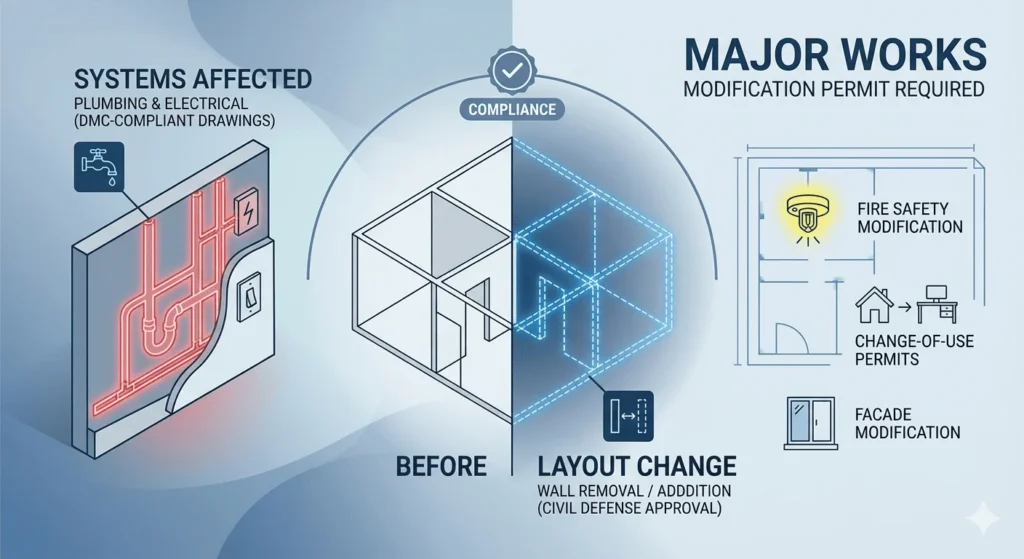
The requirement for official approval for interior works arises when the proposed changes go beyond minor works (such as cabinet replacement) and affect the property’s structure or essential systems, including electrical and plumbing networks.
In such cases, it is essential to understand how interior designers can prepare Dubai Municipality-Compliant Drawings from the start to ensure that all required permits and approvals are obtained from the municipality or relevant authorities (such as Civil Defense) before commencing any work.
The following is a list of key interior works that require an interior modification permit in Dubai:
- Removal or addition of walls and reconfiguration of internal layouts.
- Modification of electrical, plumbing, or HVAC networks.
- Relocation or alteration of fire protection and alarm systems.
- Major redesign of kitchens and bathrooms.
- Change of space usage, such as converting an apartment into an office.
- Modification of façades or addition of new windows and doors.
While minor works such as painting, flooring replacement, wallpaper installation, or furniture replacement typically do not require official permits like Clinic Fit-out Approval in Dubai.
Which authorities issue interior modification approvals?
Interior fit-out and modification approvals are issued by various governmental and regulatory authorities, including Dubai Municipality, free zone authorities such as JAFZA, Dubai Civil Defense, and utility service providers such as DEWA.
The determining authority for modification approvals depends on the property’s location and the type of works required.
Therefore, it is essential to understand the difference between DM, Trakhees, DDA, and JAFZA approvals, as these authorities primarily ensure compliance with building codes and safety regulations (such as the provision of emergency exits).
Below is a list of the main authorities responsible for issuing modification permits:
- Dubai Municipality (DM): Issues approvals for interior modifications and fit-out works through its digital services (such as self-licensing services for eligible interior works).
- Dubai Civil Defense: Approval is mandatory when modifying fire protection systems, alarm systems, or emergency exit routes, especially in commercial projects.
This is where property owners often ask What Is the Difference Between DDA Approval and DM Approval to determine which platform should be used based on geographic jurisdiction. - Free zone authorities and developers: such as DDA and Trakhees, as well as major developers like Emaar and Nakheel, typically require a No Objection Certificate (NOC) before initiating formal approval procedures.
- Utility service providers: such as DEWA and gas service providers, particularly when modifying electrical loads or plumbing and gas connections.

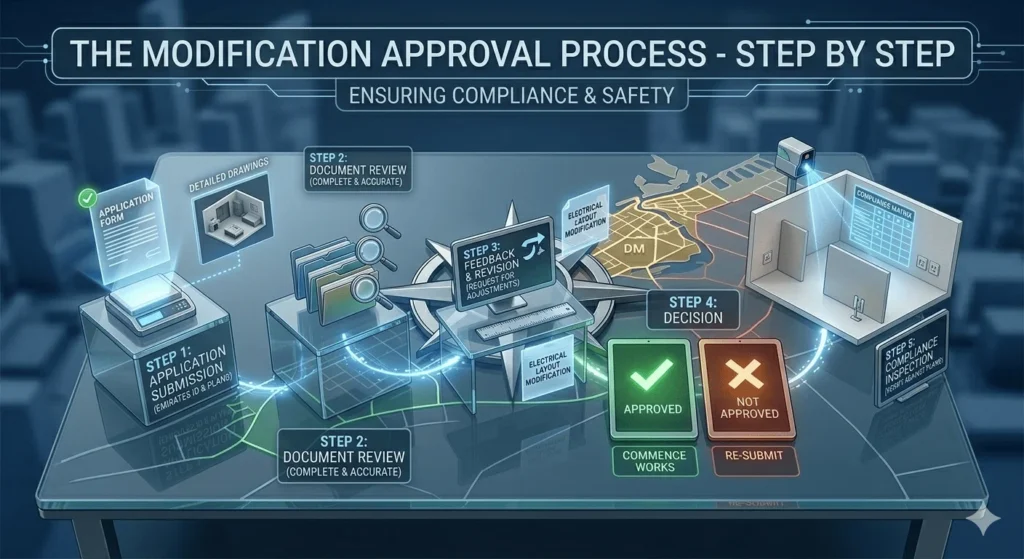
The modification approval process: step by step
The modification approval process in Dubai begins with the submission of an application including detailed drawings and identification documents (such as a copy of the Emirates ID).
The application is then reviewed by Dubai Municipality to ensure that all documents are complete and accurate (for example, a missing copy of the Emirates ID).
Based on the review findings, the authority may request additional information or revisions to the submitted drawings (such as adjustments to the electrical layout).
After that, a decision is issued either approving or rejecting the application. If approved, modification or fit-out works may commence.
As a final step, an inspection team is deployed to verify that the completed works comply with the approved drawings (for example, confirming that the new wall locations match the approved plans).
These procedures are particularly critical when obtaining DDA Approvals for Office Projects in Dubai, especially for the fit-out and preparation of administrative and commercial spaces.
💡Discover all DCD-Compliant Design Tips Interior Designers Often Miss to ensure successful modification approvals and a smoother DDA approval process.
Documents required for interior modification approval
Documents required for interior decoration approval include legal, identity, and ownership documents such as the title deed, personal identification documents such as Emirates ID, No Objection Certificates (NOC) from the main developer or building management.
In addition to drawings and technical engineering plans (such as MEP drawings), as well as approvals from external authorities such as DEWA approval.
Below is a list of the documents required for interior modification approvals in Dubai:
- Legal, identity, and ownership documents: These include the title deed or land plot plan (for property owners), a valid tenancy contract (for tenants), along with Emirates ID, passport copy and visa copy for individuals, and a valid trade license for commercial properties.
- No Objection Certificates (NOC): These include the official letter issued by the master developer (such as Emaar and Nakheel) or building management approving the commencement of works, in addition to written consent from the property owner if the applicant is a tenant.
- Drawings and technical engineering documents: These include architectural drawings (existing and proposed), MEP system drawings, and structural drawings with engineering calculations (in case of structural modifications), as well as fire and life safety drawings, all of which must be approved and stamped by a licensed consultant in Dubai.
- External authority approvals: These include Civil Defense (DCD) approval when modifying fire systems or using specific approved interior materials, as well as a No Objection Certificate from Dubai Electricity and Water Authority (DEWA) when requesting increased electrical loads or modifications to main water or plumbing lines.
How long does modification approval take?
The time required to obtain approval for minor interior modifications (such as decorative renovation works) typically ranges from 2 to 5 working days, whereas structural modification approvals (such as column alterations) may take between 4 to 8 weeks.
The approval timeline varies depending on:
- Project size.
- Complexity of the proposed changes.
- Completion of required documents and approvals.
Any missing drawings or pre-approvals can lead to significant delays in issuing the final permit, particularly in cases where applicants are unfamiliar with procedures such as how to get DDA approval for safety officers.
Timelines also vary depending on the issuing authority. For example, Dubai Development Authority (DDA) may issue approvals within a few days, while approvals from Dubai Municipality or No Objection Certificates (NOC) from developers may take several weeks, especially for large-scale or complex projects.
How much does interior modification approval cost?
The cost of obtaining an interior modification approval typically ranges from AED 200 to AED 1,500 (USD 50–300), while fees for structural modifications or large-scale projects may increase to AED 3,500–7,500 or more (USD 2,500–15,000).
The overall cost of modification approval varies depending on the type of work, project size, and the authority responsible for issuing the permit.
Additional charges may also apply based on the nature of the project, such as:
- Civil Defense fees for modifications involving fire protection systems, HVAC, or electrical works.
- No Objection Certificate (NOC) fees from the developer or building management.
- Fast-track service fees for expedited approval processing.
In addition, most projects require approved engineering drawings prepared by a licensed engineering consultant or interior designer based on the Documents Required for DDA Approval.
The cost of preparing these drawings typically ranges from AED 3,000 to AED 15,000, and may be higher for larger or more complex projects.
Common reasons modification approvals are rejected
The reasons for modification approval rejections in Dubai vary and often include the submission of incomplete documents, such as a missing No Objection Certificate (NOC) from the building management, or submitting applications to the wrong authority due to a lack of understanding of the Difference Between DDA and JLT Approval or other free zone jurisdictions, which results in submitting the file through the incorrect platform.
Rejections may also occur due to the absence of required external authority approvals, such as Civil Defense approval, or incorrect classification of the consulting firm.
In addition, existing violations within the property itself can lead to immediate rejection, as applications are often declined during the drawing and documentation review stage.
The most common reasons for rejection of modification approvals include:
- Submission of incomplete or incorrect documents, such as missing No Objection Certificate (NOC) or the use of unapproved drawings.
- Submission through an engineering consultancy that is not licensed for the type of modification required.
- Failure to clearly define whether the works are structural modifications or minor interior fit-out works.
- Mismatch between submitted drawings and the actual site conditions, or the presence of existing violations.
- Lack of required approvals from relevant authorities such as Civil Defense or utility providers.
- Submitting the application to an incorrect authority or through the wrong platform for the property location.
💡Skip the Rejections and Get Approved with DAEM!
Don’t let a missing document or incorrect layout stall your project.
Contact DAEM now to handle your entire approval process with DM, DDA, and Civil Defense flawlessly.
Execute your interior modifications in Dubai with confidence through the proper official approvals
In Dubai, interior alterations are not limited to aesthetics, they are governed by strict regulatory procedures and compliant safety standards.
For this reason, securing an interior modification approval in Dubai helps protect your project from:
- Delays.
- Regulatory violations.
- Future rework.
If you are planning to modify a residential unit or a commercial space in Dubai, you can contact the team at DAEM Contracting for specialized consultation and full support to deliver your project smoothly and efficiently.
Frequently Asked Questions:
1- Who approves interior modifications in Dubai?
Dubai Municipality is the primary government authority responsible for approving property modifications and structural works within the emirate.
For alterations that involve adding or removing walls, or undertaking major maintenance, detailed architectural plans must be submitted through an approved contractor to secure an official permit before any work begins.
2- Can I start decoration work before final approval is granted?
No, any modifications, demolition, or extensions are prohibited before official permits are issued, as this may result in fines or project suspension by Dubai’s regulatory authorities.
3- Is it necessary to work with an approved contractor to obtain approval?
In most cases, yes. The relevant authorities require that the application and work be carried out through a licensed and approved contractor or consulting firm within Dubai.
Comments are closed