

Did you know that a single unauthorized excavation activity or lane closure on Dubai’s roads without an RTA row permit could expose your project to fines of up to AED 30,000 and even lead to the suspension of works?
In Dubai, effective regulation of the public right of way forms the foundation for:
✔️ Protecting critical infrastructure
✔️ Ensuring traffic safety
For this reason, moving a project from the planning stage to on-site execution requires an rta approval expert to ensure that traffic management plans and engineering drawings are prepared accurately.
In this article, DAEM Contracting explains everything you need to know about RTA road approvals, including when they are required and how to obtain them efficiently.
Contact Us Now!
Your Project, Our Priority: Fast & Reliable Approvals
Table of Contents
What is RTA Row Permit?
An RTA ROW Permit is an approval issued by the Roads and Transport Authority (RTA) that allows works to be undertaken within the public right of way, such as electricity and water network extensions, as well as maintenance and construction activities that may affect roads or sidewalks.
RTA approval is typically required in Dubai by contractors (such as DAEM), developers (such as Emaar), and service providers (such as car rental companies) to:
- Ensure that works are carried out in accordance with approved standards (such as protection of utility networks).
- Maintain the safety of road users.
- Prevent disruption to traffic flow.
RTA Row Permit system also requires coordination with the relevant authorities (such as DM and DDA) to protect existing infrastructure and comply with the following requirements:
- Safety requirements like placing protective barriers.
- Necessary traffic diversions.
- Reinstatement of the site to its original condition upon completion of the works.
💡Discover everything you need to know about obtaining an RTA approval and the required documentation through DAEM’s approval services.
Why do you need Row Permits from RTA?
RTA approvals Dubai are required for any activity carried out within roads in Dubai, whether it involves sidewalk modifications or the extension of water utility networks, as such works may affect infrastructure and traffic safety.
RTA permits cover a wide range of activities, including excavation and construction works, utility network extension and maintenance, modifications to sidewalks and access points, installation of roadside elements such as signage, activities involving road occupation and the use of heavy equipment such as paving works, as well as any road closures or traffic diversions.
Accordingly, RTA row permits are required in the following cases:
- Road Construction and Excavation Works: such as the Hessa Street Development Project.
- Utility Installation and Maintenance Projects: such as sewerage works.
- Traffic Diversions and Lane Closures: such as partial road closures.
- Installation of Roadside Infrastructure: such as Intelligent Traffic Systems (ITS).
- Public Events Affecting Roads and Pedestrian Areas: such as sporting events.
💡Are you looking for an rta approval expert in dubai to obtain Roads and Transport Authority permits quickly and without errors?
Contact DAEM Contracting to secure fast and reliable RTA approvals.
1- Do I need an RTA permit for road excavation works?
An RTA Right of Way Permit is required before carrying out any excavation works within roads or the public right of way in Dubai, in order to access the site and mobilize heavy equipment such as excavators to commence excavation works.
This also includes obtaining RTA Construction NOCs, as well as permits for construction entrances and exits in cases where these works are followed by building construction.
RTA approvals ensure coordination with service authorities such as DEWA to protect underground infrastructure (like sewerage lines), it also require the submission of an approved plan from RTA and Traffic Police for traffic movement, which must include the following safety measures:
- Barriers.
- Directional signage.
- Traffic diversions.
Carrying out excavation works without the required RTA permits is considered a violation of regulations that may result in:
- Immediate suspension of work.
- Financial penalties of up to AED 50,000 (approximately USD 13,615).
💡Discover all Common Mistakes in Obtaining RTA Approval and avoid anything that could delay or disrupt your project success.

2- Do utility installation and maintenance projects require an RTA ROW permit?
Utility installation and maintenance works (such as water network extensions) require RTA approval in order to carry out works within the public right of way in Dubai, these works typically include extension or maintenance of water, sewerage, electricity, and telecommunications networks or any works that involve excavation or road occupation to complete the works, such as surface reinstatement.
In contrast, RTA ROW services ensure the following:
- Protection of existing infrastructure.
- Traffic management through approved traffic diversion plans.
- Requiring the executing party (whether contractor or developer) to reinstate the road to its original condition after completion of the works.

3- Do traffic diversions and lane closures require approval from RTA?
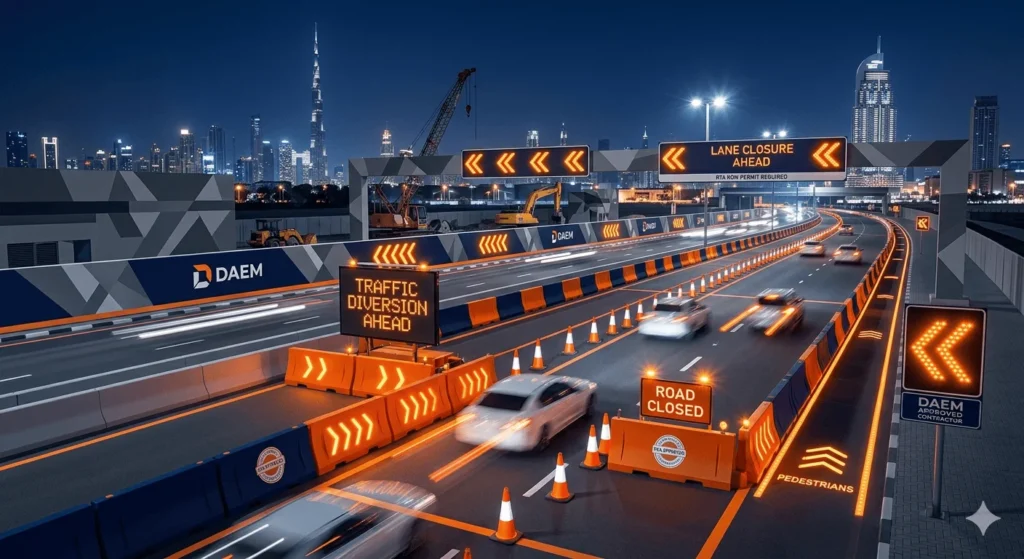
All traffic diversions and lane closures in Dubai require prior approval from RTA, as this is done through rta row permit login to the row services permit system, which includes Required Documents for RTA Approval and ensures the following:
- A Traffic Management Plan (TMP) outlining alternative diversion routes.
- Pedestrian flow management.
- Clear definition of closure timings and locations.
Traffic diversions and traffic management activities are restricted to RTA-approved contractors (such as DAEM). RTA ROW permit requests are typically reviewed within a few working days, depending on the size of the project and its engineering and operational scope.
4- Do I need an RTA ROW permit to install roadside infrastructure?
A Right of Way Permit RTA is required before installing any roadside infrastructure or facilities within the road right of way in Dubai, including:
- Street lighting poles.
- Protective barriers.
- Directional signage.
- Pedestrian facilities.
- Utility boxes.
- Parking shelters.
An RTA ROW Permit is essential for infrastructure works carried out within the road right of way, even when no direct work is performed on the road surface itself, it also requires the contractor or developer to comply with the following:
- Technical specifications, such as utility alignments.
- Access and traffic movement requirements within the affected area, including the design of safe entry and exit points for vehicles.
💡Save time and avoid project delays with DAEM, your trusted partner for RTA permits for infrastructure and road right of way works.
5- Are RTA permits required for public events that affect roads or pedestrian areas?
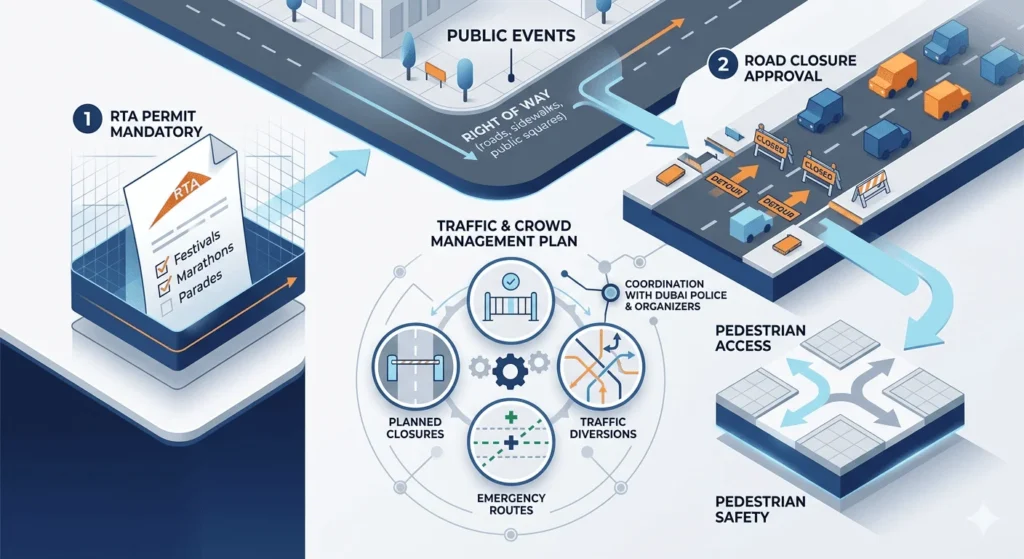
Yes, RTA permits are mandatory for any public events that impact roads or pedestrian areas, such as festivals, marathons, and parades, so in such cases, a road closure permit must be obtained in advance before any site setup or preparation works begin.
And the purpose of RTA permits is to:
- Ensure smooth traffic flow.
- Maintain public safety.
RTA permits require the submission of a Traffic and Crowd Management Plan outlining:
- Road closures.
- Traffic diversions.
- Emergency routes.
- Safe pedestrian access routes.
Coordination with relevant authorities, such as Dubai Police and event organizers, is also required, ensuring compliance and avoiding disruption of public transport services.
How DAEM Helps You Obtain an RTA Right of Way Permit?
DAEM RTA approval expert supports you in obtaining an RTA Right of Way Permit by managing the entire permitting process from the early project stages through to final approval as follows:
- Site assessment and scope definition: The project site is evaluated in detail, and all planned activities within the road right of way are clearly identified.
- Preparation of technical documentation: The engineering team prepares all required documents, including engineering drawings, site layouts, traffic management plans, construction methodologies, and road reinstatement plans after completion.
- Application submission and follow-up: The application is submitted through the RTA electronic system for approved contractors, with continuous monitoring of all review and technical assessment stages, including responses to comments and required revisions.
- Final approval process: After obtaining the required RTA approvals, the client is supported in completing fee payments and insurance requirements, followed by issuance of the final permit.
Effective Project Continuity Starts with Proper ROW Permit Management
Whether your project involves deep excavation works, utility network extensions, or even the installation of roadside shelters and barriers, the RTA ROW Permit covers all such activities to ensure the protection of Dubai’s advanced infrastructure and the safety of all road users.
Accordingly, leave the administrative and technical approval processes to the experts at DAEM Contracting, and focus on the quality and execution of your project on site.
Frequently Asked Questions:
1- How long does it take to obtain an RTA ROW Permit?
The duration for obtaining an RTA ROW Permit typically ranges between 5 to 10 days through the E-NOC system.
2- What is the difference between an RTA ROW Permit and eNOC?
eNOC is a preliminary technical approval of the drawings, whereas the RTA ROW Permit is the final permit that authorizes the execution of works on site within the road right of way.
3- Can individuals apply for an RTA ROW Permit?
No, individuals are not permitted to apply for an RTA ROW Permit, because the applications must be submitted through approved companies, contractors, or consultants registered with the Roads and Transport Authority.
Comments are closed