

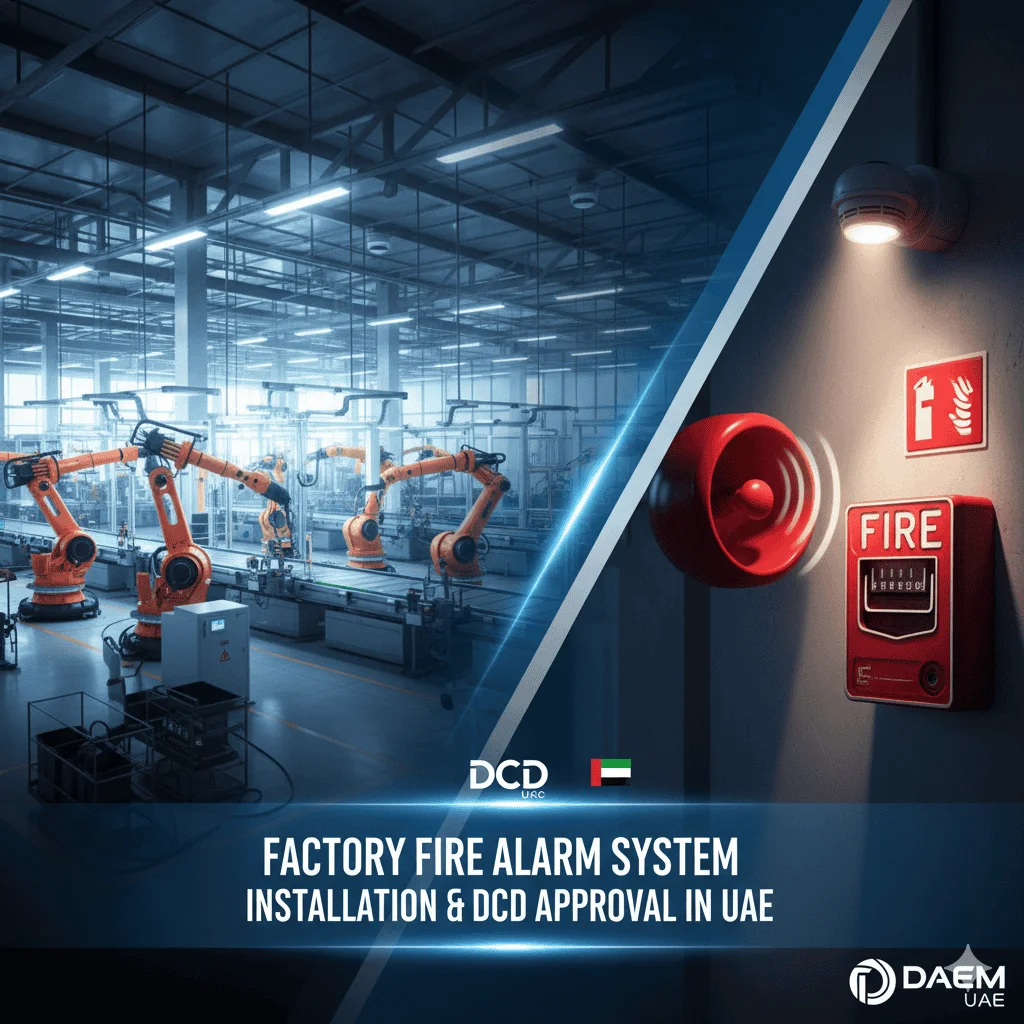
Factory Fire Alarm System in Dubai doesn’t start with purchasing the latest machinery or hiring hundreds of workers; it begins by ensuring your premises won’t be legally “shut down” before your first production cycle even begins.
Building a luxury factory without an appropriate fire alarm system is like installing a jet engine on a wooden boat; it looks powerful, but it will never take off.
Ignoring precision in this process can cost you more than just money:
❌ Halted production while awaiting operating permits.
❌ Expensive re-piping and re-wiring after construction is complete.
❌ DCD fines that show no mercy to your operating budget.
On the other hand, smart technical compliance grants you:
✔ A 100% legal and safe industrial launch.
✔ Real protection for lives and supply chains.
✔ Faster issuance of the Completion Certificate to start generating profits.
In this guide, we take you behind the scenes of NFPA standards and DCD requirements to reveal how to choose a system that doesn’t “scream” without reason, but rather protects assets and ensures you pass official inspections professionally on the first attempt.
Contact Us Now!
Your Project, Our Priority: Fast & Reliable Approvals
Table of Contents
What is Factory Fire Alarm System for factories?
According to NFPA 72 (National Fire Alarm and Signaling Code) and NFPA 101 (Life Safety Code), a fire alarm system for a factory is an engineered solution designed to detect fire hazards early, aligning with the specific hazard classification of the facility (Light, Ordinary, or High). It alerts occupants through integrated audible and visual notification appliances.
These factory fire alarm systems rely on a network of advanced sensors, such as explosion-proof detectors and beam detectors. These are geographically distributed using an intelligent addressing method that pinpoints the fire location with high precision, even in harsh industrial environments like high-temperature zones or areas containing flammable materials (oil).
The function of Industrial Fire Alarm Systems extends beyond mere alerts; they integrate with safety control systems to execute automatic responses, such as:
Shutting down HVAC and ventilation units.
Activating specialized fire suppression systems (e.g., FM-200 or foam systems).
Transmitting automatic signals to monitoring centers like the Hassantuk fire alarm system.

At DAEM, we believe that excellence in delivering Fire Systems Services is the only guarantee for sustainable safety in major industrial facilities.
Why Factory Fire Alarm Systems in UAE Require Special Design?
Installing a fire alarm system in UAE industrial zones requires specialized engineering due to extreme operational conditions (high heat and humidity) and high-risk activities like oil refining.
The UAE Civil Defense mandates strict technical standards, such as the mandatory use of volt-free contacts, to ensure system reliability and uninterrupted operation.
Key reasons for factory alarms’ specialized design include:
Extreme Environmental Conditions: Temperatures exceeding 50°C and fine dust require ruggedized fire alarm devices capable of withstanding these factors.
Strict Local Regulatory Framework: Designs must follow the “UAE Fire and Life Safety Code of Practice.” Every phase is reviewed by a DCD-approved fire safety engineer, including requirements like 24-hour backup battery capacity.
High-Risk Industrial Nature: UAE facilities often handle petrochemicals, plastics, and chemical storage, necessitating a robust fire alarming system.
Don’t leave safety to chance, leverage our expert Fire alarm Systems Services to guarantee seamless integration, from initial design approval to final installation and maintenance.
How is Factory Hazard Classified?
Factory hazard levels are classified according to NFPA 101 (Life Safety Code) and NFPA 1 (Fire Code) by studying the nature and quantity of combustible materials, the type of industrial processes within the facility, and the potential speed of fire spread and its impact on life and property.
Accordingly, industrial facility risks are divided into the following categories:
Light Hazard: A factory is considered a light hazard if it contains very limited quantities of combustible materials with low flammability, such as packaging and wrapping workshops.
Ordinary Hazard: Factory risks are classified as ordinary if they contain moderate quantities of combustible materials with low to medium ignitability, such as wooden furniture factories.
High Hazard: A factory is considered high risk if it contains highly flammable liquids or gases, or materials capable of causing a dust explosion, such as gasoline and diesel storage facilities.

From massive factories to a precision-engineered restaurant fire alarm, DAEM delivers the ultimate Fire Systems Services and Solutions.
Types of Fire Alarm Systems Suitable for Factories
Choosing the most suitable alarm system for factories depends on the size of the factory and its hazard classification. The conventional system is used in factories with limited risks and simple operational requirements (simple equipment manufacturing workshops), while addressable systems are adopted in factories that require precise fire location identification and better alarm management, such as automotive factories.
As for advanced smart systems, they are used in industrial environments with high risks or complex operations (oil refineries). Additionally, a wireless fire alarm system can be used in some industrial facilities with structural constraints or complex metal structures.
The following table illustrates the appropriate alarm systems for each factory:
| System Type | Suitable Factory Size | Hazard Classification (NFPA) | Applications |
| Conventional System | Small | Ordinary Hazard | Small furniture factories, simple equipment workshops |
| Addressable System | Medium to Large | Ordinary to Extra Hazard | Automotive and assembly plants, electronics factories |
| Intelligent System | Medium to Extra Large | Extra Hazard | Oil refineries, petrochemical plants, pharmaceutical factories |
| Wireless System | Various (Design defined) | Ordinary to High | Factories with complex metal structures that obstruct wired installations |
DCD Approval Process for Factory Fire Alarm Systems (Step-by-Step)
The process of obtaining Civil Defense approval for a factory alarm system begins with appointing a certified consultant to conduct a factory risk assessment and prepare appropriate design layouts, such as detector distribution drawings, to be submitted via the DCD website.
After submitting the documents and receiving DCD approval, on-site execution begins in preparation for submitting the final accreditation request to DCD, following the successful completion of the technical inspection by inspectors.
The following is a list of steps to obtain DCD approvals for the fire alarming system in your factory:
Design and Pre-Review Phase: Begins by appointing a consultant engineer and a contractor approved by DCD, such as DAEM CONTRACTING COMPANY, who takes over the preparation of the fire alarm systems design layouts based on the risk assessment, then submits them via the DCD PORTAL to obtain the Design NOC.
Implementation and Inspection Phase: The approved contractor starts the fire alarm system installation according to the approved drawings and coordinates with DCD to conduct stage inspections to verify concealed conduits and wiring within walls or ceilings and pass them.
Operation and Final Handover Phase: After installation, the contractor performs a comprehensive functional test and inspection of the system and prepares the test report. Then, the final inspection request is submitted along with the test report and accurate (As-Built Drawings).
Final Inspection and Certificate Issuance: A DCD inspector visits the site to verify compliance and conduct practical tests. After addressing any remarks and passing the inspection, DCD issues the Final Approval certificate , which allows the factory to operate.
Cost of Factory Fire Alarm System in UAE
The cost of installing a factory fire alarm system in the UAE ranges from AED 20,000 to +500,000 UAE Dirhams, which is equivalent to ($5,450 – $136,200).
Factories fire alarm system cost depends on the size of the factory (area and number of floors), the hazard classification, which may require higher-priced systems such as addressable ones, and the required equipment specifications, such as using a dust-resistant smoke detector instead of a standard smoke detector.
The following table illustrates the factors affecting the price of fire alarm systems:
| Factor | How it Affects the Price |
| Factory area and number of floors | Increased area means an increase in the number of detectors, manual call points, and control panels. |
| Factory hazard classification | High-hazard factories require addressable systems and specialized fire alarm devices at a higher cost. |
| Type of fire alarm system | The conventional system is less expensive, while addressable and intelligent systems are higher. |
| Type of detectors used | Dust-resistant or heat-resistant detectors are more expensive than standard detectors. |
| Civil Defense (DCD) requirements | Includes design, inspection, and the final fire alarm system service for accreditation. |
July 17, 2025.. The day the firefighting system proved to be more valuable than the machinery!
In the industrial world, results are the only thing that speaks. On July 17, 2025, a factory in Ras Al Khaimah faced its toughest test; a massive fire broke out suddenly, but the result was not as catastrophic as everyone expected.
Not a single injury was recorded, and the factory did not turn into rubble. The reason? The factory alarm system did its job: it bought time.
Our final question to you: If danger knocks on your factory door tomorrow, will the alarm system open a path to safety, or will it stand silent watching your dreams evaporate?
Do not let your facility be a “lesson” that others learn from; instead, make it a “model” of safety.
As a leading fire alarm company in dubai, we provide comprehensive protection. Do not wait for smoke to confirm your decision.. Contact DAEM today, the experts among fire alarm system suppliers in dubai, and ensure you stay in the market tomorrow.
Frequently Asked Questions:
1. What type of fire alarm system is suitable for warehouses?
The suitable fire alarm system for warehouses depends on the warehouse type, size, ceiling height, and stored materials, with systems typically combining smoke, beam, or HSSD detectors approved by DCD.
2. Does a factory fire alarm system require a DCD approval?
Yes, a factory fire alarm system requires a DCD approval to ensure compliance with Dubai’s safety regulations.
3. Are manual call points required in commercial fire alarm systems?
Yes, manual call points are mandatory in commercial fire alarm systems to allow occupants to manually activate the alarm if a fire is detected.
Comments are closed