

Fitout approvals in Dubai is a strict requirement that controls how any space is designed and approved, yet navigating it can feel overwhelming due to the many authorities and regulations involved.
Every step, from designing the layout to securing approvals, is closely monitored by authorities to ensure patient safety, operational efficiency, and compliance with healthcare standards.
Yet for many owners, obtaining pharmacy fitout approval in Dubai can feel overwhelming, with multiple agencies, documents, costs, and timelines to manage.
Discover which documents are required, the common challenges that can delay approvals, the costs and timelines you should realistically expect, and the crucial role consultants and contractors play in ensuring success.
By the end, you’ll not only understand how to secure approval but also why doing it right enhances credibility, protects patients, and sets your pharmacy up for long-term growth in Dubai’s competitive healthcare sector.
Contact Daem Contracting LLC today to start your pharmacy fitout journey with confidence.
Contact Us Now!
Your Project, Our Priority: Fast & Reliable Approvals
Table of Contents
What is Pharmacy Fit-out Approval?
Pharmacy fitout approval in Dubai is the official process of securing permits and inspections to ensure that a pharmacy’s interior design meets stringent healthcare standards.
These requirements align with DCD Fitout Approval Requirements and broader Dubai fit out regulations, covering layout planning, fire safety, workflow design, and cold-chain compliance.
It involves coordination with DHA, DM, and DCD, often with support from interior fit out contracting companies in Dubai, such as Daem Company, to meet structural, safety, and operational regulations. Pharmacies must obtain a pharmacy fitout permit, supported by a Dubai NOC certificate, and pass checks by the Civil Defence approval Dubai authority. Some facilities must also meet smart-safety guidelines, such as integration with the hassantuk system.
Why Pharmacy Fitout Approval Matters?
Securing pharmacy fitout approval in Dubai is essential because it protects patients by ensuring safe dispensing workflows that prevent medication errors, for example, ensures compliance through cold-chain storage systems that keep vaccines and temperature-sensitive drugs effective, and builds trust with patients and regulators by demonstrating secure handling of controlled medicines such as narcotics, in line with Dubai healthcare facility licensing rules.
Fitout approvals also confirm that facilities meet Dubai healthcare fitout and medical centre fitout Dubai standards, reducing risks of drug spoilage and contamination.
Additionally, approval demonstrates credibility to patients, insurers, and regulators, helping owners avoid costly re-inspections or fines..
What Are The Requirements for Obtaining Pharmacy Fitout Approval?
To secure a pharmacy fitout permit in Dubai, owners must meet strict technical, safety, and regulatory standards by coordinating with multiple authorities, including the Dubai Health Authority (DHA), which reviews pharmacy layouts to ensure safe dispensing workflows and patient privacy; Dubai Civil Defence (DCD), which enforces fire safety rules such as installing sprinklers and smoke detectors; Dubai Municipality (DM), which oversees building codes and sanitation systems like proper drainage and waste disposal; Dubai Development Authority (DDA), which ensures compliance with zoning and development regulations for commercial spaces; and Trakhees (EHS), which monitors environmental health and safety measures such as ventilation systems and hazardous material handling.
Each authority plays a role in ensuring that pharmacies are safe, functional, and legally compliant.
Below is a list of the key requirements that must be met to get a pharmacy fit-out approval:
- Layout & Design Compliance: Pharmacies must submit floor plans that follow medical clinic design standards, ensuring efficient workflows and patient safety. This includes clear separation of dispensing counters, counselling areas, and cold-chain storage, such as layouts prepared by interior fitout consultants in Dubai who specialise in healthcare projects.
- Safety Approvals: Facilities must obtain Civil Defence approval in Dubai for fire safety, ventilation, and emergency exits, along with an NOC certificate from building management. This means installing fire-rated doors, smoke detectors, and emergency lighting, such as those required under DCD fire safety rules.
- Healthcare Licensing: Fitouts must comply with healthcare facility licensing Dubai requirements, including NABIDH connectivity and appointment of a licensed Pharmacist-in-Charge. This involves integrating EMR systems and compliance policies, such as those mandated by DHA consultant Dubai guidelines.
- External Authority Clearances: Pharmacies located in free zones or specialised developments must secure additional approvals, such as zoning compliance from DDA or structural safety checks from Trakhees (EHS), alongside standard DM health and safety clearances.
- Contracting & Execution: Partnering with experienced contractors ensures smooth delivery and compliance with Dubai fit out regulations.
💡 Understanding How fit-out contractors can avoid project delays with fast DCD inspections helps reduce back-and-forth cycles and avoid penalties.
What is The Process to Secure Pharmacy Fit-out Approval Step-by-Step?
Securing pharmacy fitout approval in Dubai follows a structured path that ensures compliance with Dubai Health Authority (DHA) standards, such as designing safe dispensing areas and cold-chain storage for medicines; Dubai Civil Defence (DCD) fire safety rules, including installing smoke detectors, sprinklers, and clearly marked emergency exits; and Dubai Municipality (DM) regulations, such as proper sanitation systems and waste disposal facilities. Each stage requires careful planning and coordination with consultants—for example, healthcare consultants preparing compliant layouts—and contractors, such as MEP specialists installing medical refrigerators and fire-rated partitions, to guarantee that the pharmacy meets all technical and safety requirements before licensing.
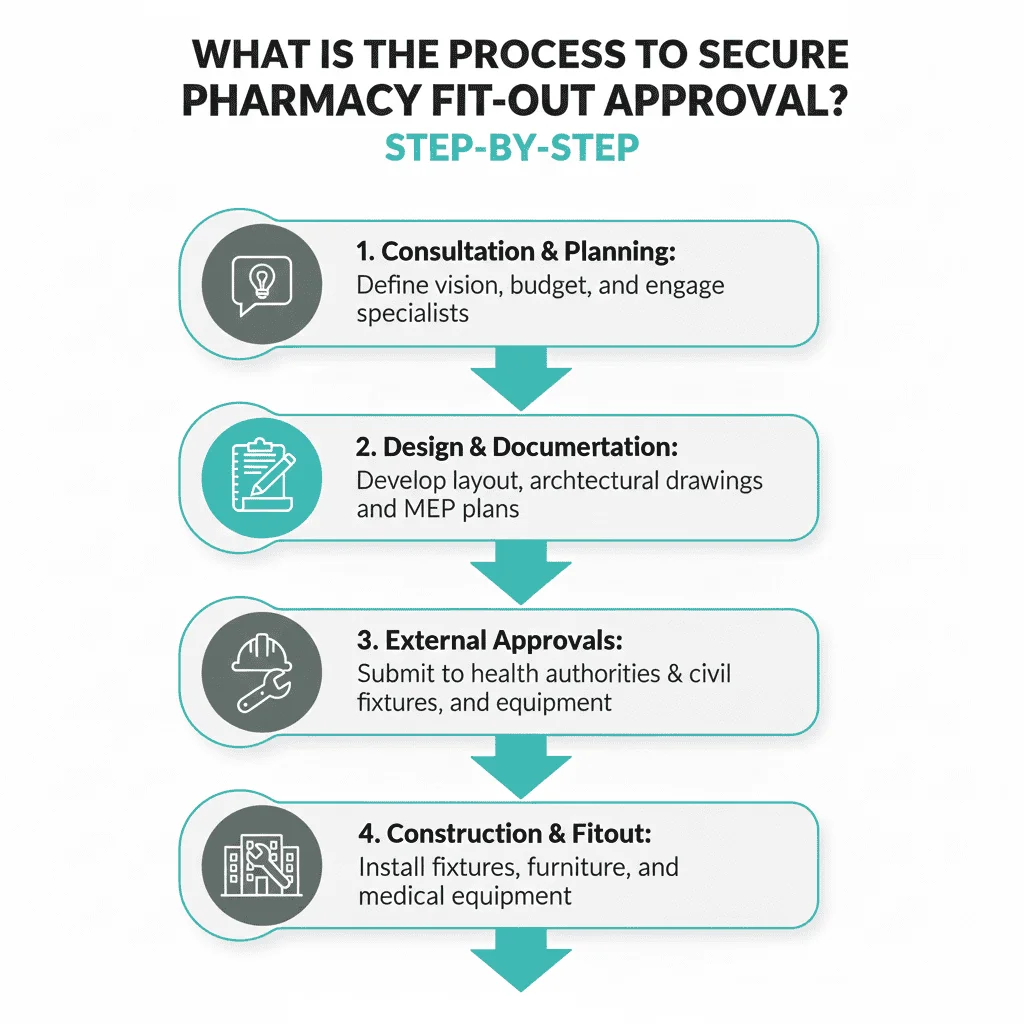
Below are the steps of the process to secure pharmacy fitout approval in Dubai:
- Consultation & Planning: Owners begin by engaging interior fitout consultants in Dubai, who prepare architectural designs that comply with DHA guidelines, such as layouts that separate dispensing areas from counselling zones and cold-chain storage.
- Design & Documentation: Detailed architectural and MEP drawings must be submitted to DHA and DM, such as plans that include ventilation systems, fire exits, and patient-friendly layouts.
- External Approvals: Pharmacies must secure clearances from multiple authorities, such as Dubai Civil Defence approval for fire safety, NOC certificate from building management in Dubai, and additional permits from Dubai Development Authority (DDA) or Trakhees (EHS) if located in free zones.
- Construction & Fitout: Contractors implement the approved design, partnering with interior fit out contracting companies in Dubai to ensure compliance with Dubai fit out regulations.
- Final Inspection & Activation: DHA conducts inspections to ensure compliance. Once approved, the pharmacy receives its facility license, valid for 1–3 years.
What Are the Documents Needed to Obtain a Pharmacy Fit-Out Approval in Dubai
To obtain a pharmacy fitout approval in Dubai, owners must prepare a complete set of documents, including architectural layouts such as floor plans showing dispensing counters and storage areas; clearance letters from landlords or building management confirming tenancy rights; safety certifications like fire alarm and sprinkler system approvals from Dubai Civil Defence; municipal endorsements verifying compliance with sanitation and waste disposal standards; additional authority permits such as radiation shielding approval if diagnostic equipment is installed; licensing records demonstrating compliance with Dubai Health Authority requirements for pharmacy operations; and contractor-issued compliance evidence, for example, certificates confirming that HVAC systems and medical refrigerators were installed according to specifications.
These records demonstrate compliance with Dubai Health Authority (DHA) standards, Dubai Civil Defence (DCD) fire safety rules, and regulations from Dubai Municipality (DM), Dubai Development Authority (DDA), and Trakhees (EHS).
Here is a detailed list of the required documents to obtain a pharmacy fitout permit in Dubai:
- Facility Floor Plan: Detailed architectural drawings prepared by interior fitout consultants in Dubai, showing dispensing areas, counselling zones, cold-chain storage, and emergency exits, in line with medical clinic design standards.
- NOC Certificate Dubai: A No Objection Certificate from building management confirming that the planned modifications comply with structural and safety guidelines.
- Civil Defence Clearance: Documentation proving compliance with DCD fire safety rules, such as fire-rated doors, smoke detectors, and emergency lighting installations.
- Dubai Municipality Approvals: Health and safety clearances from DM, such as ventilation, hygiene, and accessibility compliance.
- External Authority Permits: Depending on location, pharmacies may need additional approvals from DDA or Trakhees (EHS), especially for free zone or specialised healthcare projects.
- Healthcare Licensing Documents: DHA facility license application, NABIDH connectivity confirmation, and appointment of a Pharmacist-in-Charge, such as those required under healthcare facility licensing in Dubai.
- Contractor Compliance Certificates: Proof of work completed by interior fit out contracting companies in Dubai, such as Daem Contracting LLC, demonstrating adherence to Dubai fit out regulations and fitout service standards.
What Are The Common Challenges While Applying for A Pharmacy Fit-out Approval & How to Overcome Them?
When applying for pharmacy fitout approval in Dubai, owners often encounter extended construction timelines, such as delays caused by waiting for HVAC system installation or fire safety inspections; repeated inspections, for instance when Dubai Civil Defence requires multiple site visits to verify sprinkler and alarm systems; incomplete paperwork, such as missing clearance letters or unsubmitted medical refrigerator compliance certificates; overlapping authority requirements, where approvals from Dubai Municipality and DHA must be coordinated to avoid conflicting standards; and underestimated budgets, for example overlooking the costs of radiation shielding or specialized cold-chain storage units. These challenges highlight the importance of thorough planning and consultant coordination to ensure smooth approval.
Addressing these challenges early ensures smoother compliance with Dubai Health Authority (DHA) standards, Dubai Civil Defence (DCD) fire safety rules, and regulations from Dubai Municipality (DM), Dubai Development Authority (DDA), and Trakhees (EHS).
Here are the full details of the Common Challenges While Applying for A Pharmacy Fit-out Approval & How to Overcome Them:
- Delays in Fitout Completion: Construction timelines can stretch when contractors are unfamiliar with healthcare requirements, such as Dubai Health Authority (DHA) standards or medical clinic design standards. Choosing specialised interior fit out contracting companies in Dubai, such as Daem Contracting LLC, helps avoid rework and ensures compliance from the start.
- Re-Inspection Costs: Pharmacies may fail initial checks if fire safety or workflow layouts are incomplete, such as missing emergency lighting required under Dubai Civil Defence (DCD) fire safety rules. Careful pre-inspection with consultants reduces the risk of paying additional re-inspection fees.
- Documentation Errors: Submitting incomplete or outdated paperwork, such as missing a NOC certificate, or failing to upload NABIDH connectivity proof, can stall approvals. Working with a DHA consultant in Dubai ensures all records meet healthcare facility licensing requirements in Dubai.
- Coordination Across Authorities: Pharmacies located in free zones or mixed-use developments often need overlapping approvals, such as zoning clearance from Dubai Development Authority (DDA) or structural safety checks from Trakhees (EHS). Planning timelines with these agencies early prevents conflicts and delays.
- Budget Overruns: Owners sometimes underestimate costs for specialised installations, such as cold-chain storage or IT systems required under Dubai fit out regulations. Partnering with experienced fitout service providers helps manage budgets and ensures compliance without compromising quality.
What Are The Costs & Timelines for Pharmacy Fitout Approval?
The costs for pharmacy fitout approval in Dubai vary depending on the scale of the project, the complexity of the design, and the number of authorities involved. Regulatory fees alone can range from AED 200 to AED 10,000, covering charges such as fitout permits calculated per square foot by agencies like the Dubai Development Authority (DDA) or Dubai Municipality (DM).
Beyond approvals, the overall fitout expenses typically fall between AED 150,000 and AED 500,000, reflecting construction works, specialised installations, and compliance with Dubai Health Authority (DHA) standards, Dubai Civil Defence (DCD) fire safety rules, and Trakhees (EHS) requirements.
These costs often include design consultancy, cold-chain storage systems, fire-rated doors, NABIDH connectivity, and contractor services provided by experienced firms such as Daem Contracting LLC.
In terms of timelines, pharmacy owners should expect the process to take 6–12 weeks from the initial design submission to the final DHA inspection and activation.
This period covers multiple stages: preparing architectural layouts, securing external approvals (such as NOC certificates and Civil Defence clearance), completing construction and fitout works, and undergoing final inspections.
Projects that engage specialised interior fitout consultants in Dubai and plan authority coordination early often achieve faster approvals, while delays in documentation or re-inspections can extend the timeline.
Here’s a list of the fees and the expected timelines when applying for a pharmacy fit-out approval in Dubai:
- Design & Consultancy Fees: Hiring interior fitout consultants in Dubai adds upfront costs, such as preparing DHA-compliant layouts and MEP drawings. These services typically range from AED 10,000–30,000, depending on complexity.
- Authority Approval Charges: Regulatory bodies charge fees for permits and inspections. For example, Dubai Development Authority (DDA) applies a fitout permit fee of AED 0.90 per sq. ft. (minimum AED 200, maximum AED 10,000), plus small administrative charges.
- Construction & Fitout Costs: The largest expense comes from execution, such as installing cold-chain storage, fire-rated doors, and NABIDH connectivity systems. Full pharmacy fitouts often cost AED 150,000–500,000, depending on size and materials.
- External Authority Fees: Pharmacies in free zones may face additional charges, such as zoning permits from DDA or safety checks from Trakhees (EHS). These vary but can add AED 5,000–20,000 to the budget.
- Inspection & Activation Timeline: DHA schedules inspections, such as verifying storage conditions, workflow efficiency, and IT integration. Approval timelines typically range from 6–12 weeks, depending on document accuracy and coordination with authorities
What Are The Benefits of Proper Fitout Approval?
Securing pharmacy fitout approval in Dubai delivers advantages that enhance patient safety, such as DHA‑mandated cold‑chain storage systems that keep vaccines effective; improve operational efficiency, for example, through DM‑approved layouts that separate dispensing, storage, and customer areas to streamline workflows; strengthen credibility, by complying with DCD fire safety rules like installing sprinklers and smoke detectors that reassure both regulators and patients; and support long‑term business growth, through adherence to DDA zoning regulations and Trakhees (EHS) environmental health standards, which enable sustainable expansion and licensing continuity. These outcomes collectively ensure that pharmacies operate legally, safely, and with lasting trust.
- Enhanced Patient Safety: Approved pharmacies follow strict guidelines, such as DCD fire safety rules and medical clinic design standards, ensuring safe storage of medicines, proper ventilation, and secure emergency exits.
- Regulatory Compliance: Fitout approval demonstrates adherence to healthcare laws, such as DHA standards and healthcare facility licensing in Dubai, reducing risks of penalties or closure.
- Operational Efficiency: Well-designed layouts improve workflows, such as separating dispensing counters from counselling areas and integrating NABIDH connectivity for faster patient service.
- Credibility & Trust: Passing inspections builds confidence among patients, insurers, and regulators, such as when pharmacies secure clearances from DM, DDA, or Trakhees (EHS).
- Business Growth: Compliance supports expansion opportunities, such as opening branches, joining insurance networks, or partnering with healthcare clusters. Working with experienced contractors, such as Daem Contracting LLC, ensures scalability while maintaining quality.
Pharmacy Fitout Approval in Dubai – What Owners Should Remember
Obtaining pharmacy fitout approval in Dubai is not just a regulatory obligation but a strategic step toward building a safe, efficient, and credible healthcare business. The process spans several stages, from consultation and design to external approvals, construction, and final inspection, each requiring close coordination with authorities such as the Dubai Health Authority (DHA), Dubai Civil Defence (DCD), Dubai Municipality (DM), Dubai Development Authority (DDA), and Trakhees (EHS). Success depends on preparing accurate documentation, budgeting realistically for both authority fees and construction costs, and managing timelines that typically range from six to twelve weeks. By engaging experienced consultants and contractors, such as interior fitout consultants in Dubai and trusted firms like Daem Contracting LLC, pharmacy owners can avoid delays, reduce re-inspection risks, and ensure compliance with Dubai fit out regulations. Ultimately, proper fitout approval enhances patient safety, strengthens operational efficiency, and builds long-term credibility, laying the foundation for sustainable growth in Dubai’s competitive healthcare sector.
Frequently Asked Questions:
1. Can a pharmacy operate in Dubai without fitout approval?
No. Operating without a proper pharmacy fitout approval from the Dubai Health Authority (DHA) and other relevant agencies is considered non-compliant and can result in fines, closure orders, or denial of a facility license.
2. Is pharmacy fitout approval required for renovations or only for new pharmacies?
Yes, pharmacy fitout approval is required for both new pharmacies and renovations. Even if the pharmacy is already licensed, any structural changes, layout modifications, or safety system upgrades must be approved before implementation.
3. How does pharmacy fitout approval differ from clinic fitout approval?
No, A Self-Decor Permit is not the same as a Fit-Out Permit; the former covers minor cosmetic works, while the latter is required for major structural or system modifications.
4. What happens if a pharmacy fails the final DHA inspection?
If the pharmacy fails inspection, DHA issues a report highlighting deficiencies. The owner must correct these issues — such as fire safety gaps or improper medicine storage — and request a re-inspection. This can delay opening and add costs.

Comments are closed