

A single minute of negligence in Al Quoz warehouses has previously cost millions; do not let your facility become the next headline due to delayed Dubai Civil Defense Approval.
In industrial facilities, the danger is not limited to fire alone, but extends to explosions, flammable materials, and improper storage, making DCD industrial approvals a fundamental requirement for legal and safe operation in Dubai.
This guide explores DCD requirements for industrial plants, necessary documents, and the step-by-step approval process, while highlighting costs, timelines, and the common rejection reasons you must avoid to ensure your project is approved on the first attempt.
Contact Us Now!
Your Project, Our Priority: Fast & Reliable Approvals
Table of Contents
Why DCD Approval is Mandatory for Industrial Facilities
DCD regulations for industrial facilities are mandatory to ensure safety and compliance with the UAE fire code. It prevents explosive and hazardous areas and it secures emergency exits and evacuation paths.
Here is a list of the reasons for the DCD approvals for industrial facilities:
- Presence of flammable materials.
- Improper storage of materials.
- Presence of flammable floors.
- Incorrect electrical connections.
- Presence of hazardous manufacturing processes such as welding.
- External factors such as lightning.
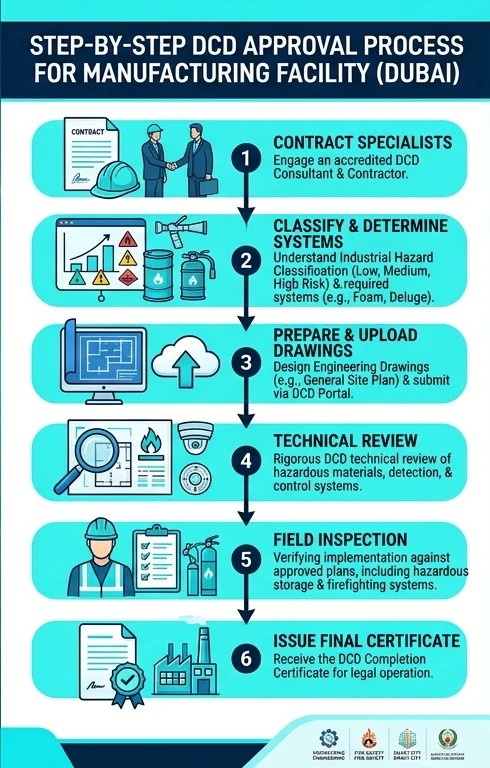
DCD Industrial Approval Workflow
The DCD approvals process for industrial facilities prioritizes actual hazard levels over mere activity types. It starts with a rigorous analysis of flammable materials and manufacturing workflows to define the precise Hazard Classification. Based on this, protection systems, such as Foam, Deluge, or Explosion-Proof Systems, are engineered and reviewed.
The Industrial project then undergoes a technical audit that correlates hydraulic calculations with system selection and hazard zoning, culminating in a field inspection to verify real-world integration rather than simple drawing compliance, which is essential for issuing the safety certificate from Dubai Civil Defence.
Required Documents for DCD Approvals for Industrial Facilities in Dubai
The documents required for Civil Defense approvals for Industrial Facilities include specialized legal and engineering documents, such as the trade license, architectural and MEP plans, as well as industrial safety documents, such as the Fire Risk Assessment report.
The following is a list of documents required to obtain the DCD approval for the factory:
1. Basic Legal Documents
Trade License (Industrial Activity): To determine the type of activity and its associated hazard level.
Tenancy Contract or Title Deed: To prove ownership or legal use of the site.
No Objection Certificates (NOC): To ensure approval from regulatory authorities such as free zones (e.g., JAFZA approval) for the industrial activity.
2. Engineering Plans and Safety Systems
Dubai Municipality (DM) Approval for Architectural Plans: To define space distribution and escape routes.
MEP Plans (Mechanical, Electrical, and Plumbing): To ensure system integration with safety requirements.
Fire & Life Safety Plans: To illustrate the distribution of firefighting and fire alarm systems according to the fire code.
Hazard Classification Plan: To determine if the facility is low, medium, or high hazard, and thus define the required firefighting system type.
3. Specialized Industrial Safety Documents
Hazardous Materials Storage Plan: To clarify storage locations for flammable (e.g., fuel) or explosive materials and their isolation methods.
Fire Risk Assessment Report: To analyze potential fire scenarios based on the nature of the industrial activity.
Process Flow Diagram: To understand the flow of materials within the factory and identify hazard points.
Explosion Protection Documents (ATEX): To ensure equipment safety in flammable environments.
How is hazard classification determined in industrial facilities?
Industrial Hazard Classification in facilities is determined based on a set of factors related to fire behavior. These include material flammability, heat release rate, the nature of operations (manufacturing or storage), and the method and density of storage, all in accordance with NFPA 13 requirements.
If a project involves materials or processes with a high hazard rate that leads to rapid and violent fire spread, such as the use or storage of significant quantities of flammable liquids or gases, it is classified as Extra Hazard (referred to as High Hazard in some codes). Meanwhile, medium-risk industrial activities are classified under Ordinary Hazard, and environments with a low fuel load fall under Light Hazard.
Hazard Classification Table for Industrial Facilities (Based on NFPA 13 & UAE Fire Code):
| Classification | Technical Summary | Key Examples | Required Systems |
| Light Hazard (LH) | Low fuel load & slow fire growth. | Offices & Control Rooms | Standard Sprinklers (Low Density) |
| Ordinary Hazard (OH1) | Moderate combustibility; light production. | Electronics & Assembly | Sprinklers + Hose Reel System |
| Ordinary Hazard (OH2) | Higher heat release & spread potential. | Woodworking & Plastics | High-Density Sprinklers + Fire Pump |
| High Hazard (EH1) | Highly combustible; high heat release. | Rubber & Heavy Paper | Foam System or Deluge System |
| High Hazard (EH2) | Flammable liquids; rapid/violent fire. | Paints & Petrochemicals | Foam + Deluge + ATEX Compliance |
Hazard determination is conducted by DCD approved fire consultants, directly influencing both firefighting system design and total project costs. For an initial estimate before the official review, use our interactive calculator:
Hazard Calculator
💡 Stay Informed: Understand the latest Industrial-Specific DCD Requirements.
Common Reasons for DCD Approval Rejection in Industrial Projects
Common Reasons for DCD Industrial Rejections are incorrect hazard classifications that fail to reflect actual operations, followed by inadequate hydraulic calculations that don’t align with NFPA standards.
Furthermore, fire water supply issues and non-compliant alarm systems often lead to failure when they lack the necessary redundancy or a clear Cause & Effect Matrix.
Ultimately, these errors are compounded by documentation gaps and coordination clashes, which prevent DCD from verifying the project’s safety basis and result in immediate rejection.
The following is a list of the most common reasons for DCD rejection of industrial projects:
- Incomplete Fire Risk Assessments: Which can lead to serious consequences and loss of property and life if there is no clear understanding of fire hazards.
- Failure to Comply with Explosion Protection Requirements: The materials must be made of non-explosive materials that can withstand external conditions and prevent the release of flames to the area.
- Inadequate Emergency Exit Plans: Not having a proper fire escape plan can lead to disastrous results, such as blocked exits and no lights.
- Incorrect Hazard Classification: This error occurs when the site’s fire risk is misclassified. Such mistakes fail to account for the actual industrial operations, leading to immediate rejection.
Inadequate Hydraulic Calculations: Inaccurate calculations that do not align with NFPA 13 standards result in design failure. These flaws usually involve choosing the wrong water density or ignoring the Remote Area Method.
Fire Water Supply Issues: Insufficient water storage or mismatched fire pumps create critical safety gaps. The lack of redundancy ensures the system will not meet DCD’s mandatory operation duration.
Non-Compliant Fire Alarm Systems: Alarm system failures often stem from a missing Cause & Effect Matrix. These gaps mean the alarm system will not coordinate correctly with other safety measures during a fire.
Documentation and Coordination Failures: Incomplete submissions and clashes between MEP and architectural drawings stall the process. The absence of a Design Report prevents DCD from verifying the project’s safety basis.
📌 Expert Tip: Don’t make these Mistakes to avoid when getting DCD approvals.
How much do DCD approvals for industrial facilities in Dubai cost?
DCD approval costs for industrial facilities in Dubai usually start from 3,000 AED and can exceed 20,000 AED, depending on the project scale.
These expenses are driven by engineering drawing reviews for fire alarm and firefighting systems, along with specialized fees for gas and hazardous material assessments.
Since these charges are often calculated per square meter, the final cost increases based on the industrial hazard classification and the complexity of the required fire protection systems.
📝 Get Approved: Streamline your Dubai Civil Defence (DCD) drawing approval process today.
How long does it take to get Civil Defense approval for industrial facilities in Dubai?
The timeframe for obtaining Civil Defense approval for Industrial projects in Dubai typically spans 15 to 45 working days, following these stages:
Engineering Plans & Technical Prep: 7 to 15 days (depending on project complexity).
DCD Portal Submission: 1 working day.
Technical Review: 7 to 10 days by DCD engineers.
Site Inspection by DCD: 1 day (subject to site readiness and system compliance).
Approvals are the Operating Reality
Securing Civil Defense approvals for industrial facilities is the only way to safeguard your production lines and warehouses against operational disasters. The speed and cost of obtaining these approvals depend entirely on the precision of your technical documentation and its field compliance with safety codes.
Daem Contracting Company streamlines this process by ensuring:
Full Compliance: Aligning all industrial machinery and systems with mandatory safety standards.
Technical Readiness: Submitting high-quality documentation to guarantee first-time approval.
Legal Protection: Eliminating the risk of heavy fines and criminal liability by 100%.
Frequently Asked Questions:
1- What is the difference between DCD approval and a Fire NOC?
The difference between DCD NOC and a Fire NOC are that DCD approval is a comprehensive authorization covering design approval, system installation, and final inspection of fire safety systems.
A Fire NOC is a limited clearance issued at specific stages such as initial design approval or temporary permission.
2- Can I apply for DCD approval online?
yes, you can apply for DCD approval online using the DCD online platform.
3- What is Hassantuk system?
Hassantuk system is a smart fire alarm monitoring platform in Dubai that connects buildings directly to Dubai Civil Defence control room.
It enables real-time fire alerts and automatic emergency response without manual reporting.
Comments are closed