


Modifying a single wall after construction will cost you multiples of the initial design price; Start correctly or prepare to pay twice.
In Dubai, a discrepancy of a few millimeters in exit width or a minor clash between electrical layouts and firefighting systems can lead to months of delay and financial losses reaching AED 100,000! DCD Drawing Approval is not merely a routine procedure; it is a “Safety License” that accepts no compromises. It is either full compliance with the UAE Fire and Life Safety Code of Practice or an immediate halt to your project.
In this guide, we reveal the essential insights to prevent investment stalls:
-
Decoding Requirements: What does Civil Defence actually look for in architectural and mechanical plans?
-
The Error Map: How to avoid the “rejection trap” that catches 90% of investors.
-
Time & Cost: Real fees and timelines to open your doors in record time.
If you lack the luxury of time and have no budget for demolition and reconstruction, these lines are your only path to operationalizing your facility before it’s too late.
Contact Us Now!
Your Project, Our Priority: Fast & Reliable Approvals
Table of Contents
What is DCD Drawing Approval?
The civil defence approval for drawingis a specialized review process conducted by the Dubai Civil Defence (DCD) for engineering plans (Residential, Commercial, Industrial, Storage). This ensures the design adheres to the dcd fire code requirements before execution begins. For instance, the clear width of a fire staircase must not be less than 1,200 mm if the occupant load is under 2,000, and 1,420 mm if it exceeds that number.
Without this approved drawing status, you cannot obtain a building permit from Dubai Municipality or operate the facility.
Stop Waiting Start Building.
Trust proven authority approval services in Dubai and Sharjah to keep your project moving without costly setbacks.
When is DUBAI CIVIL DEFENCE Drawing Approval Required?
Securing a Dubai Civil Defence drawing approval is mandatory for all new construction, such as villas, fit-out works (interior finishes), or renovations (spatial layout changes). It is also required for any project impacting fire safety systems, such as relocating sprinklers. Furthermore, a No Objection Certificate (NOC) is needed when changing the building’s usage, such as converting a showroom into a GYM, and for warehouses or industrial facilities, especially those storing flammable materials.
Cases requiring DCD approvals include:
-
Construction Projects: New residential villas and commercial/industrial buildings.
-
Fit-out Works: You need dcd fitout approval for internal modifications like installing false ceilings, especially if they involve alarm or firefighting adjustments.
-
Renovations: Required when partitioning rooms or altering escape routes.
-
Change of Use: Converting a unit’s activity (e.g., warehouse to showroom).
-
Safety System Alts: Any changes to fire pumps or alarm zones.
-
Closed Parking: Requires specific ventilation (smoke extract fans) and fire suppression.
-
Fire Safety License: After execution, “As-Built” drawings must be uploaded to secure the final certificate required for operation.
Types of Drawings Required by DUBAI Civil Defence
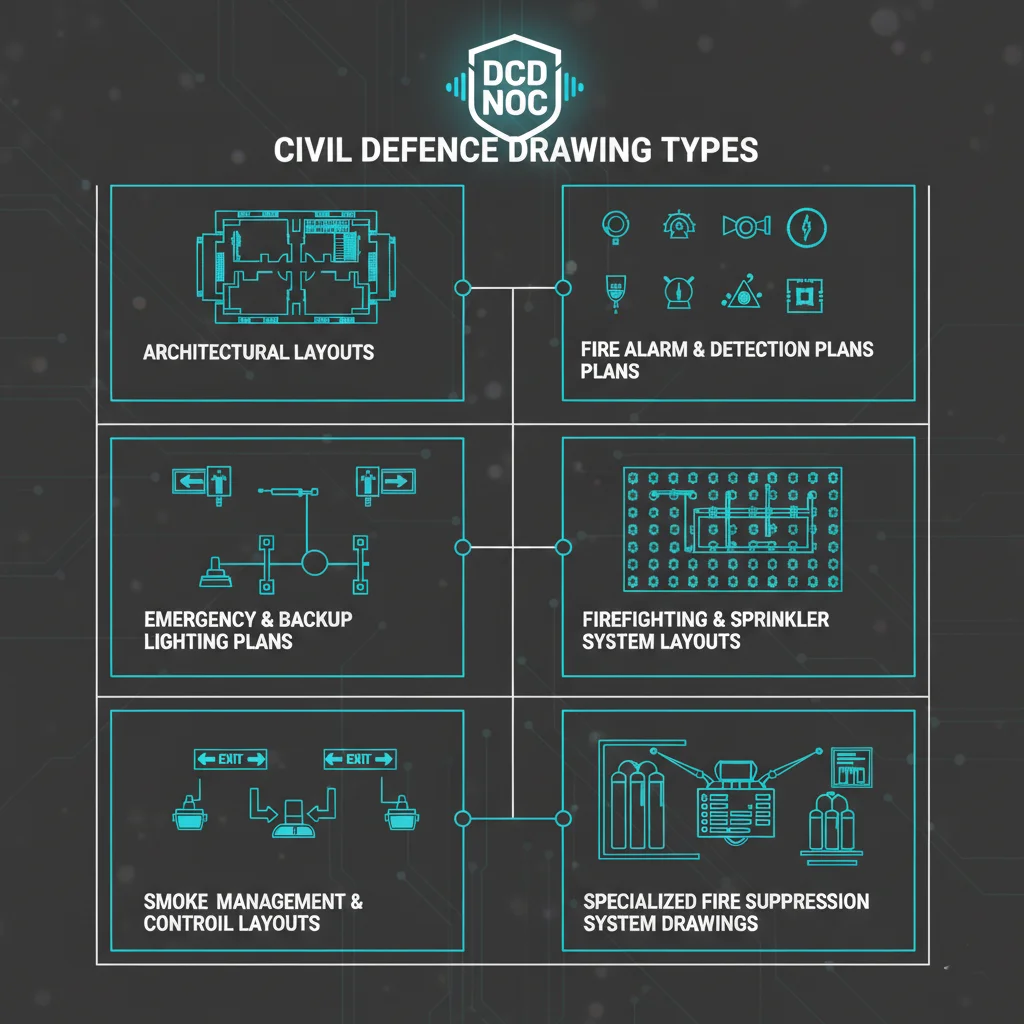
The types of plans required to obtain a Dubai Civil Defence approval encompass architectural layouts, such as the site plan identifying tank locations and pump rooms, as well as fire alarm system designs featuring control panels and detectors. Additionally, the drawing approval process necessitates the submission of fire suppression layouts, including automatic sprinkler systems and pump room configurations.
Furthermore, securing an approved drawing requires emergency lighting and egress plans that detail backup illumination units along escape routes. This is supplemented by smoke control layouts, such as extract fans, and specialized firefighting systems for sensitive areas, like FM200 for server rooms.
Below is a comprehensive list of the civil defence drawing types required for a DCD NOC:
-
Architectural Design Layouts
-
Fire Alarm and Detection Plans
-
Firefighting and Sprinkler System Layouts
-
Emergency Lighting and Exit Signage Plans
-
Smoke Management and Ventilation Layouts
-
Gas or Foam Suppression System Drawings
1. Architectural Layouts
The architectural drawings approval package must encompass a comprehensive site plan, detailing critical elements such as water tank placements and fire pump room locations. It also requires floor plans that illustrate the strategic distribution of exits, along with intricate details of staircases, focusing on their clear width, pressurization, and direction of travel.
Furthermore, the submission must specify the locations and technical specifications of fire-rated doors, ensuring the “clear opening width” meets the stringent safety standards.
The following architectural plans are mandatory for a DCD drawing:
-
Site Plan
-
Floor Layouts
-
Staircase Details (Width, Pressurization, and Direction of Flow)
-
Fire-Rated Doors: Locations and technical details (e.g., net clear width)
💡 Learn how fit-out contractors can avoid project delays with DCD inspections
2. Fire Alarm System Layouts
Fire alarm system drawings approvals necessitate a comprehensive floor-by-floor layout that precisely illustrates the placement of all fire alam system components, including detectors, manual call points, notification devices, and the control panel. Additionally, a riser diagram must be provided to delineate zone partitioning and the vertical cabling routes between different levels.
The submission must also include a detailed wiring schematic (showing device-to-panel connectivity) and a device schedule specifying the type and classification of each unit. Furthermore, a Cause and Effect Matrix is mandatory to define the functional relationship between alarm signals and the activation of integrated systems, such as elevator grounding, smoke management, and staircase pressurization.
When seconds count, reliability is your only shield
let our Fire Alarm System Services be the unblinking eye that stands between your investment and the risk of fire
3. Fire Suppression System Layouts
Fire suppression system drawings approval must include the distribution of the automatic sprinkler system, clearly indicating the spacing between sprinklers and the occupancy hazard classification. A detailed riser diagram is also required to illustrate the system’s vertical water supply and distribution.
Furthermore, the submission must be accompanied by hydraulic calculations and a comprehensive fire pump room layout, specifying the duty and standby pumps along with their respective control panels. Detailed specifications for water tanks, including their total capacity and the main filling point, must be clearly integrated into the dcd drawing to ensure full compliance with safety standards.
4- Emergency Lighting & Exit Signage Plans
The approval drawing for lighting systems must clearly illustrate the distribution of emergency light units and illuminated exit signs. It should specify the illumination levels, maintaining a minimum of 1 Lx (1 lm/m2) along the floor of the escape route, and identify the specific egress paths they cover.
Additionally, the plans must define the power source (whether via a central battery system or self-contained units) and ensure a backup duration that meets the DCD fire code standard, which is typically a minimum of 90 minutes of operational time.
5- Smoke Control System Layouts
The drawings approval for smoke management must encompass the smoke extraction system and exhaust fans, alongside pressurization plans for staircases and lobbies. These layouts must specify air change rates, ducting routes, and the sequence of operations linked to the fire alarm system.
The following is a list of essential drawings required for smoke control systems:
-
Smoke extraction system layout, identifying exhaust fan locations and their capacities in CFM.
-
Air change rates for parking structures or enclosed spaces.
-
Detailed ductwork routing and paths.
-
Sequence of Operation (SoO) diagram, illustrating the integration between smoke fan activation and the fire alarm signal to ensure a robust life safety layout in DCD drawings.
6- Special Fire Suppression System Layouts
The approval drawing for specialized firefighting systems covers gas suppression (such as FM200 or Novec), foam systems, or kitchen hood suppression. These plans must clearly illustrate the following:
-
Distribution of nozzles/heads, specifying the coverage area for each discharge point.
-
Precise locations of gas cylinders or foam tanks and their dedicated storage rooms.
-
Volume calculations for the protected enclosure and the determination of the design agent (gas) concentration.
-
Detailed Piping Layout, including pipe diameters and branching points.
-
Control panel locations and system integration with the fire alarm via a Cause & Effect Matrix.
What are the DCD Drawing Submission Requirements?
To meet Dubai Civil Defence approval requirements for drawings, all plans must be submitted in PDF format (not exceeding 50 MB), ensuring a clear and defined scale with a North arrow included to confirm the general site orientation.
Additionally, the drawings approval process requires the following:
Full Project Information: Including project name, plot number, and consultant details.
Official Validation: A stamp and signature from a dcd approved consultant.
Standardized Legends: A symbols table identifying smoke detectors, sprinklers, and other components in compliance with standards.
Sheet Indexing: Clear numbering for each layout and a revision number.
Occupancy Classification: A clear statement of the occupancy type and hazard level (e.g., Restaurant – Ordinary Hazard Group 2).
Technical Documentation: Attachment of supporting engineering calculations, such as hydraulic calculations for the sprinkler network.
Step-by-Step DCD drawing approval process
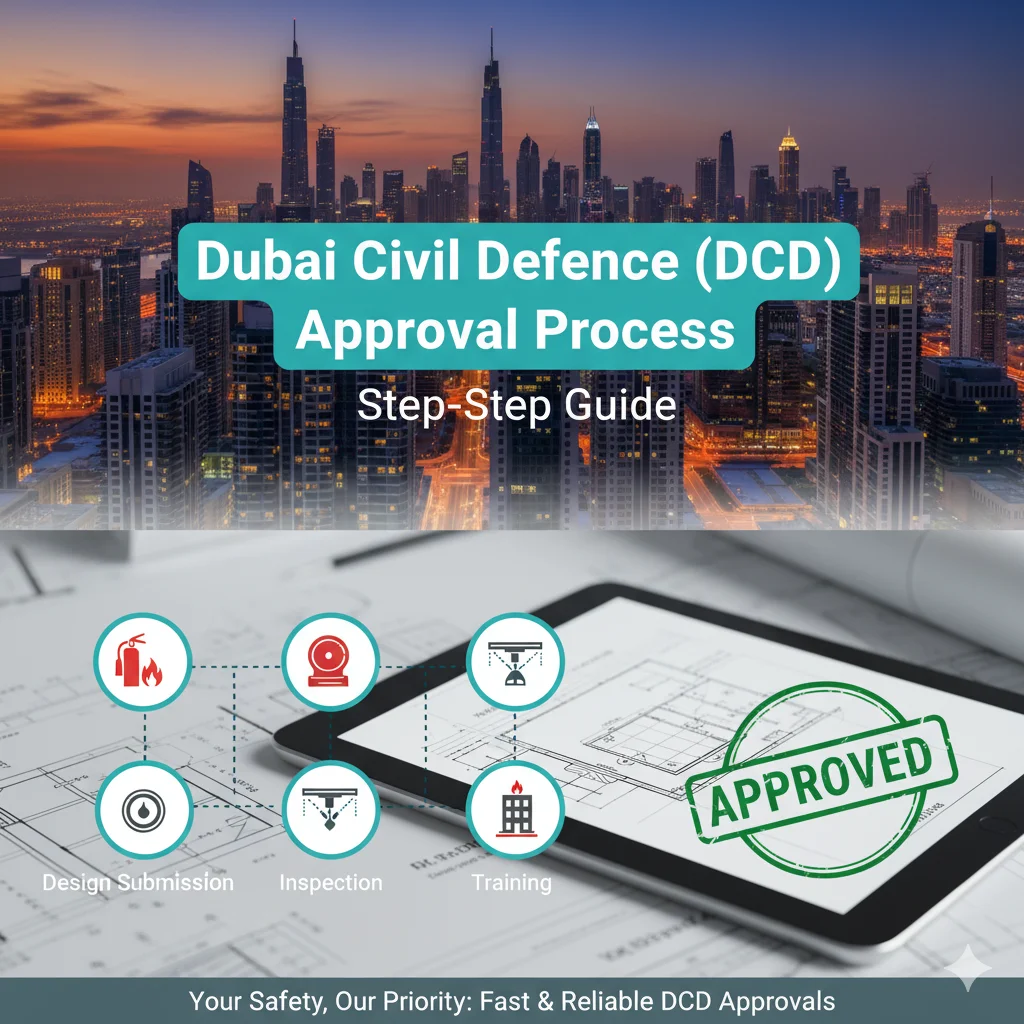
The DCD approval process for drawings begins by contracting a DCD-approved consultant, such as DAEM CONTRACTING COMPANY, to prepare the required layouts, including architectural drawings, and upload them to the DCD electronic portal via their registered account. Following this, the Dubai Civil Defence department reviews the submitted documents; if no remarks are issued, a preliminary DCD approval is granted, allowing construction works to commence on-site.
Upon project completion, the consultant submits “As-Built” drawings via the DCD portal to request a site DCD inspection. Once inspectors verify that the physical execution aligns with the approved drawing set, the final civil defence certificate is issued, authorizing the facility for operation and trade licensing.
Common Reasons for DCD Drawing Approvals Rejection
Dubai Civil Defence may reject a drawing approval request if the plans fail to comply with the DCD fire code requirements, such as using unapproved or non-fire-rated materials for walls. Rejections also occur due to technical errors or omissions, such as failing to clearly define egress paths on architectural layouts.
Furthermore, Dubai civil defence approvals are often withheld due to missing essential safety elements, like emergency lighting, or coordination clashes between architectural, electrical, and fire protection plans. Poor submission quality, including the absence of a consultant’s signature, is another frequent cause for rejection.
The following list highlights the primary reasons for DCD drawing rejection:
-
Non-compliance with UAE Fire Safety Code: Utilizing non-fire-rated materials or failing to meet required fire ratings for doors and walls (e.g., using a standard wooden door for an electrical room that requires a 1-hour fire rating).
-
Egress Path Errors: Ambiguity in escape routes, insufficient emergency exits, or exceeding maximum travel distances (e.g., a point in a large office being 60 meters from an exit when the limit is 45 meters).
-
Fire System Deficiencies: Incomplete sprinkler coverage, incorrect smoke detector placement, or the absence of required alternative suppression systems (e.g., a 100sqm server room lacking an FM200 system).
-
Missing Essential Safety Elements: Lack of emergency lighting, exit signage, or smoke ventilation systems in enclosed areas like parking garages.
-
Interdisciplinary Clashes: Discrepancies between architectural, fire, alarm, and electrical plans (e.g., an alarm detector placed where an architectural column exists).
-
Insufficient Documentation: Failure to provide hydraulic calculations, occupant load analyses, owner NOCs, or material compliance certificates.
-
Submission Quality Issues: Blurry or low-resolution plans, password-protected PDFs, or the use of non-standardized symbols.
-
Failure to Address Previous Remarks: Re-submitting rejected plans without incorporating required modifications or missing the amendment deadline.
-
Stamp and Signature Errors: Missing the official dcd approved consultant seal, lack of designer signatures, or using expired professional stamps.
🔦 Don’t pay the price of trial and error; avoid the Mistakes when getting DCD approvals to save your budget and your schedule
Estimated Timeline for Drawing Approval
The Dubai Civil Defence Drawing Approval Timeline ranges from 7 to 30 working days from the submission date. This duration depends on the project’s complexity (e.g., a simple office fit-out vs. a large-scale commercial development) and the timely completion of required documents like site layouts.
The following table outlines the estimated timelines for obtaining drawings approval based on the project category:
| Project Type | Estimated Timeline | Examples |
| Small Projects & Renovations | 7 – 10 Working Days | Small retail fit-outs (e.g., Coffee Shops) |
| Commercial & Hospitality | 10 – 20 Working Days | Hotels, Large Restaurants |
| Large & Complex Buildings | 20 – 30 Working Days | Residential Towers, Hospitals |
How much does DCD Drawing Approval cost in Dubai?
The cost for obtaining a Dubai Civil Defence drawing permit is calculated according to the Ministry of Interior’s fee schedule, based primarily on the project’s total area. For the approval of executive layouts for prevention and safety systems, the fee is set at AED 0.50 per square meter of the total built-up area.
In the event of a resubmission or modification of plans following technical remarks from the authorities, a fixed fee of AED 1,000 is applied per request. These charges ensure that the drawing approval process maintains the highest standards of safety and engineering review.
How DAEM Contracting Facilitates Your Dubai Civil Defence Drawing Approval
DAEM Contracting Company manages the entire Dubai Civil Defenceapproval process from inception to final issuance. Our services range from designing layouts according to approved safety requirements to submitting applications via the electronic portal and managing technical remarks and inspections until the DCD certificate is obtained. We guarantee full compliance with the UAE Fire Code and international standards such as NFPA.
Our comprehensive workflow for securing DCD approvals includes:
-
Regulatory Compliance: Preparing layouts that strictly adhere to DCD requirements, including emergency exits, alarm systems, automatic sprinklers, firefighting, and parking ventilation.
-
Engineering Design: Developing architectural, structural, electrical, and mechanical plans while precisely identifying the locations of alarms, detectors, extinguishers, and suppression systems.
-
Documentation Preparation: DAEM prepares a comprehensive checklist of required documents for the DCD permit, such as trade licenses, tenancy contracts, NOCs, and existing vs. proposed layouts.
-
Electronic Submission: Uploading the complete file through the Civil Defence system and auditing all data to prevent rejections or delays.
-
Remarks Management: Addressing any technical comments issued by DCD engineers and managing resubmissions as necessary to secure the approval drawing.
-
Inspection Readiness: Conducting internal audits before the official DCD inspection to ensure that site execution perfectly matches the approved plans.
-
On-site Support: Accompanying the inspection team and addressing immediate observations to ensure a successful site audit.
-
Final Certification: Uploading “As-Built” drawings post-execution to obtain the certificate of conformity (fire safety license).
-
Ongoing Consultancy: Providing continuous technical support to maintain compliance during future modifications or license renewals.
Time is ticking… Is your project ready for operation or still trapped in paperwork?
Every minute your file spends on the “pending list” waiting for dubai civil defence approvals is a tangible loss to your budget and rent paid for a space you cannot occupy due to a minor technical error. In Dubai, the market does not wait for the late, and the Civil Defence department does not overlook weak plans that fail to meet safety standards with precision.
Don’t let your investment become a “case study” for failure due to a remark that could have been avoided. At DAEM Contracting, we don’t just provide a civil defense approval Dubai; we provide speed, safety, and the certainty that your project will open its doors on schedule and at the lowest possible cost.
Stop the waste and start now! Contact us today to secure your DCD approval before technical remarks consume your launch budget.
Frequently Asked Questions:
1. What are key tips for a successful DCD inspection in the UAE?
Key tips for a successful DCD inspection in the UAE include ensuring all alarm systems and sprinklers are fully operational, having a valid maintenance contract in place, and strictly matching the approved as-built drawings from Dubai Civil Defence before the inspection date to avoid any comments or rejection.
2. What should you know before getting DCD approvals?
Before getting DCD approvals, it is essential to ensure that your fire and alarm system drawings are prepared and endorsed by a certified engineer and that a DCD-licensed contractor is appointed; Dubai Civil Defence mandates these requirements to initiate the review process and minimize any risk of rejection.
3. Are DCD approved contractors mandatory for building projects in Dubai?
Yes, DCD approved contractors are mandatory for building projects in Dubai when the scope includes fire alarm, fire fighting, or life safety systems regulated by Dubai Civil Defence.

Comments are closed